Book a call

Miserably Unemployed

A job board and AI resume tailor where the job seeker is the customer. I founded it and built it end to end, from the first idea to 2.7 million open roles read straight from employers.

2.7M
Open roles on the board
Repeat tailoring
Validation metric
3 rounds
Iteration cycles
2026–
Founder

Cycles

  • Validate
  • Iterate ×3
  • Prove
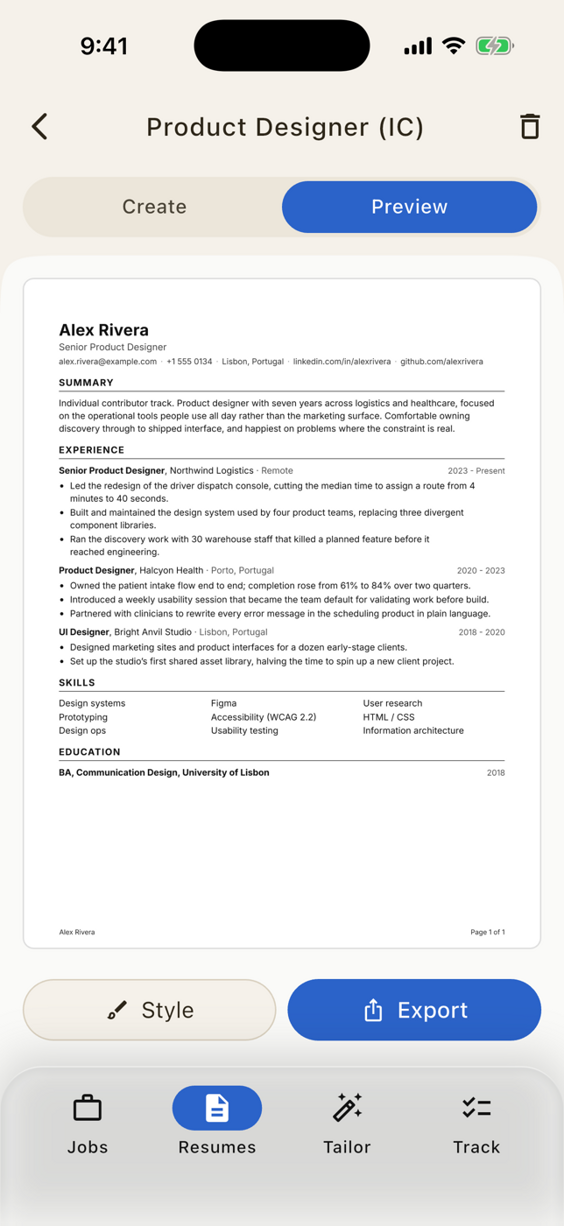
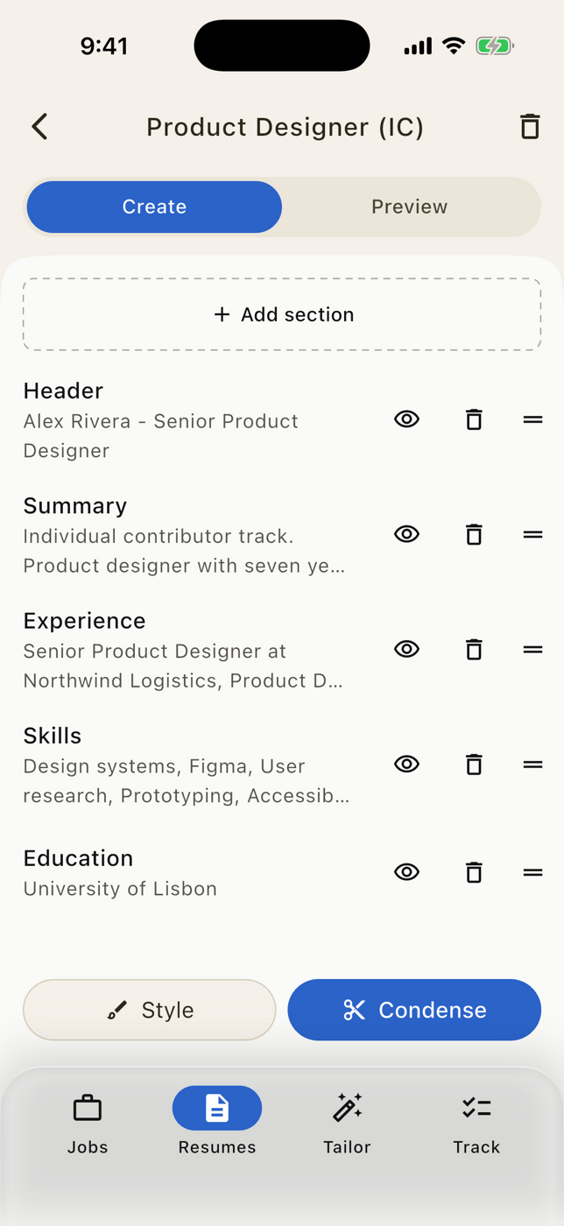
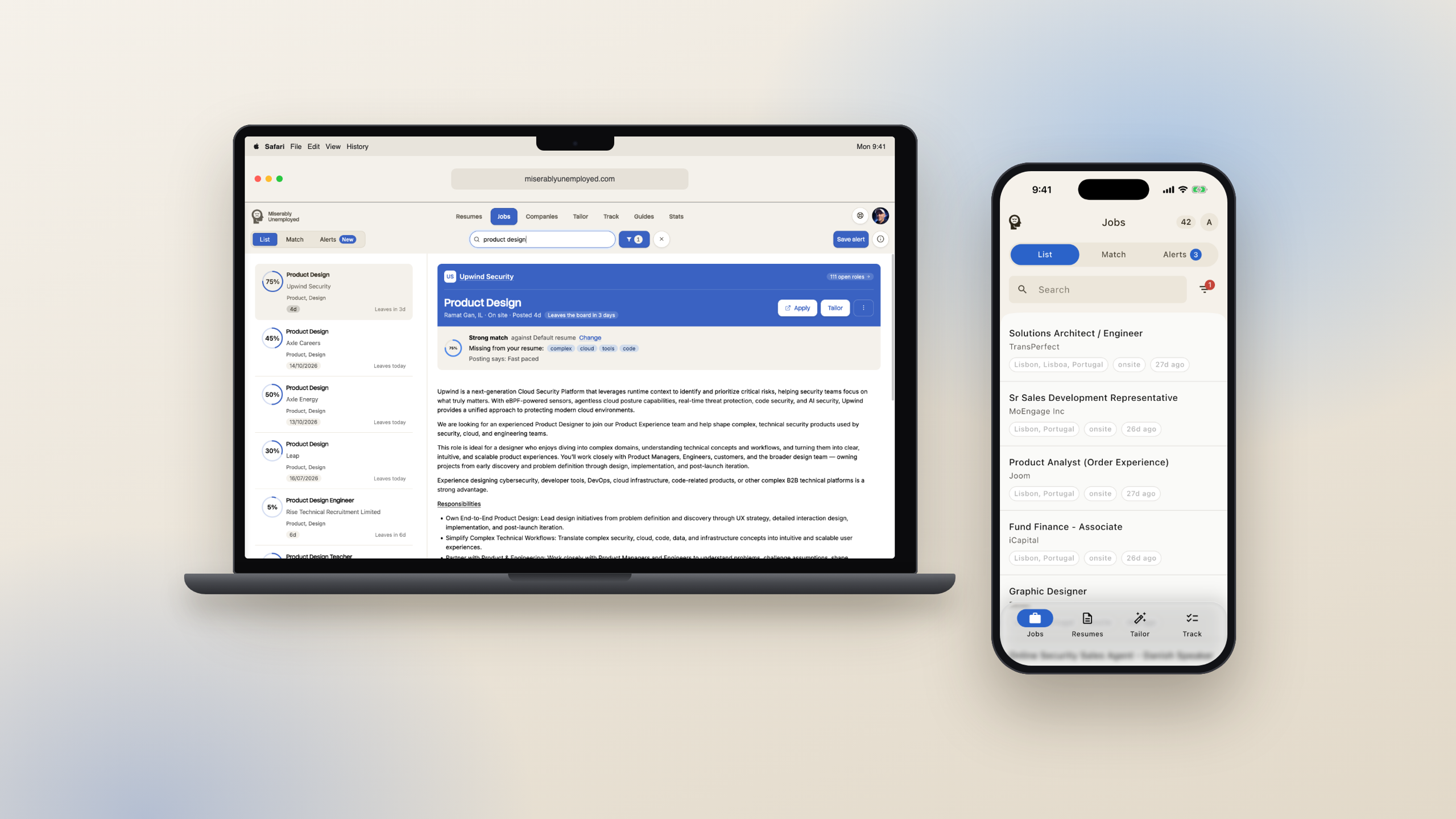
Miserably Unemployed product screens

How it was proven

  1. Validate

    I started with the expensive part: paste a job URL, get a tailored resume and cover letter back. It never invents experience. The metric: do people come back to tailor a second resume?

    First tailoring free

  2. Iterate 1

    People needed roles worth tailoring for. I built a job board that reads straight from the systems that employers post into, not from other job boards.

    2.7M roles from 13 ATS platforms

  3. Iterate 2

    At 22,000 rows the board felt slow. I split the monolith into separate API, scraper, and UI services, and rebuilt every hot path.

    Cold listing query: 6,000 ms → 424 ms

  4. Prove

    A public pledge that the product keeps: no employer has ever paid us, closed roles leave the board, and every listing opens to everyone two hours after we add it.

    26,213 companies, zero paid placements

The idea

Job boards make their money from employers, so the job seeker becomes the inventory. Listings go stale, roles that closed months ago stay up, and the same posting shows up five times. Miserably Unemployed turns that around: the job seeker is the customer, and no employer has ever paid us, for anything.

What I built

Everything: product, design, and code. A web app, an API, a scraper that reads 13 applicant tracking systems every few hours, AI resume tailoring with cover letters, a resume builder with live ATS scores, an application tracker, public market stats, and an iOS app that is still on the way.

  • Product
  • Design
  • Frontend
  • Backend
  • AI

How it’s built

The product runs as a few small services instead of one big app: the website, an API, a scraper, and notifications. Each one does one job. The scraper can read thousands of employer feeds without slowing the site down, and the website and the iOS app talk to the same API, so a feature ships once and works everywhere.

The resume work runs on AI, but only on the parts that cost money to run. That is why tailoring is paid and everything else is free.

Speed was the hardest problem. A board with millions of open roles has to feel instant, or people leave. I measured every slow step and fixed them one at a time. Warm boots went from 31,000 ms to 18 ms. The cold listing query went from 6,000 ms to 424 ms. A source-filtered index took one query from 3,290 ms to 13 ms, 252 times faster. For users, that means the board opens at once, filters answer as you click, and a job opens with no spinner.

The features

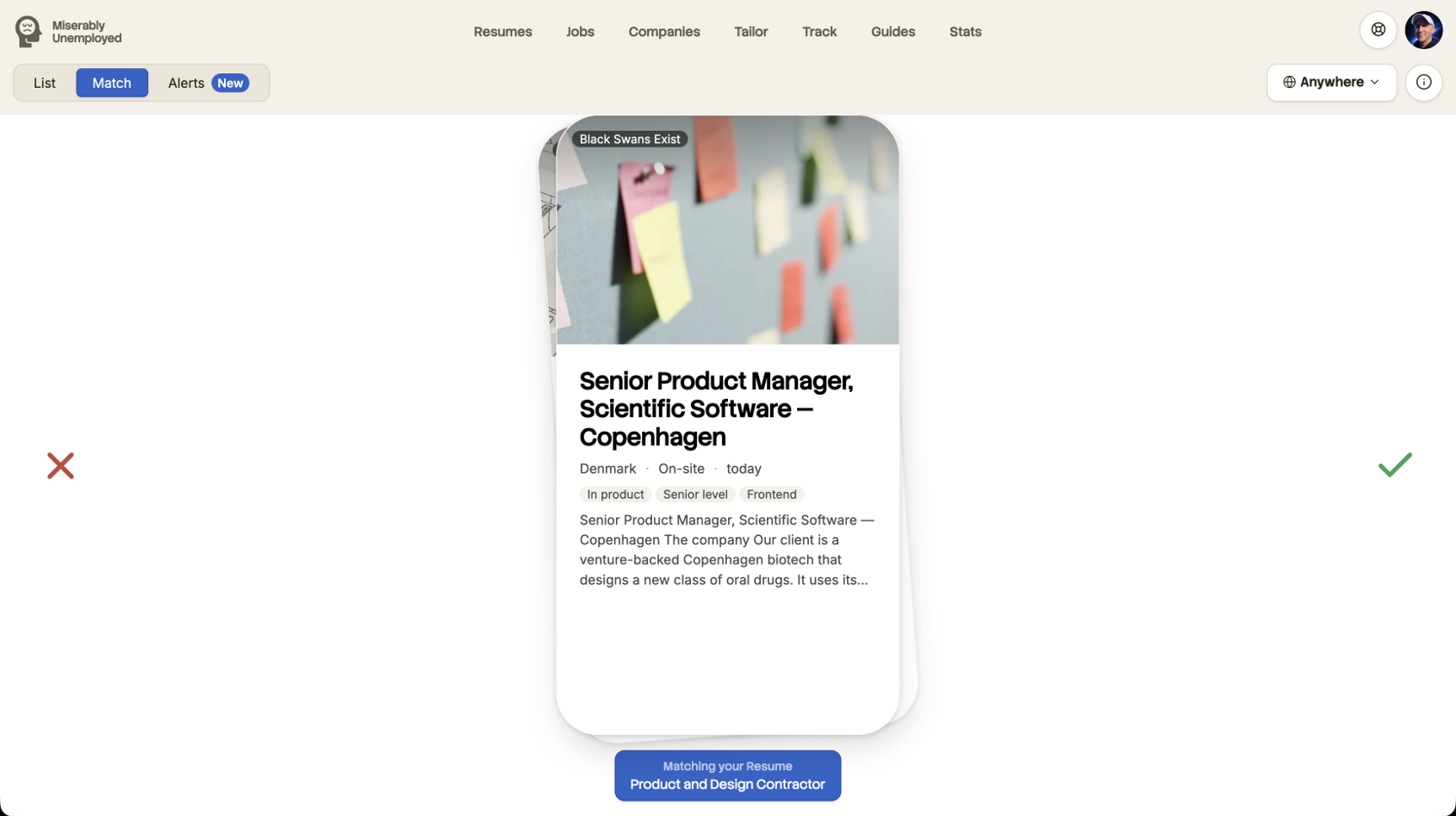
The job board Every role here comes straight from the employer’s own hiring system. The match score on the left, the countdown to when a role leaves the board, and the filters up top all exist so you can trust what you see.

Why we built it
Other boards make their money from employers, so stale and duplicate listings stay up. I wanted a board that reads straight from the systems employers post into: Greenhouse, Ashby, Lever, Workday, and nine more, refreshed every few hours.
Why it stayed
It is the reason people come. In June a user told us exactly that: the live board, read from the source, is the product. Everything else had to support it.
How it changed
Past 12,000 rows, the same “remote in the US” arrived in seven spellings, and duplicates crept in. I normalized locations, removed duplicates, added drill-down filters, and made closed roles leave the board after four days.
What users say
“Finally a board where the jobs are actually open. I stopped wasting evenings on roles that closed months ago.”
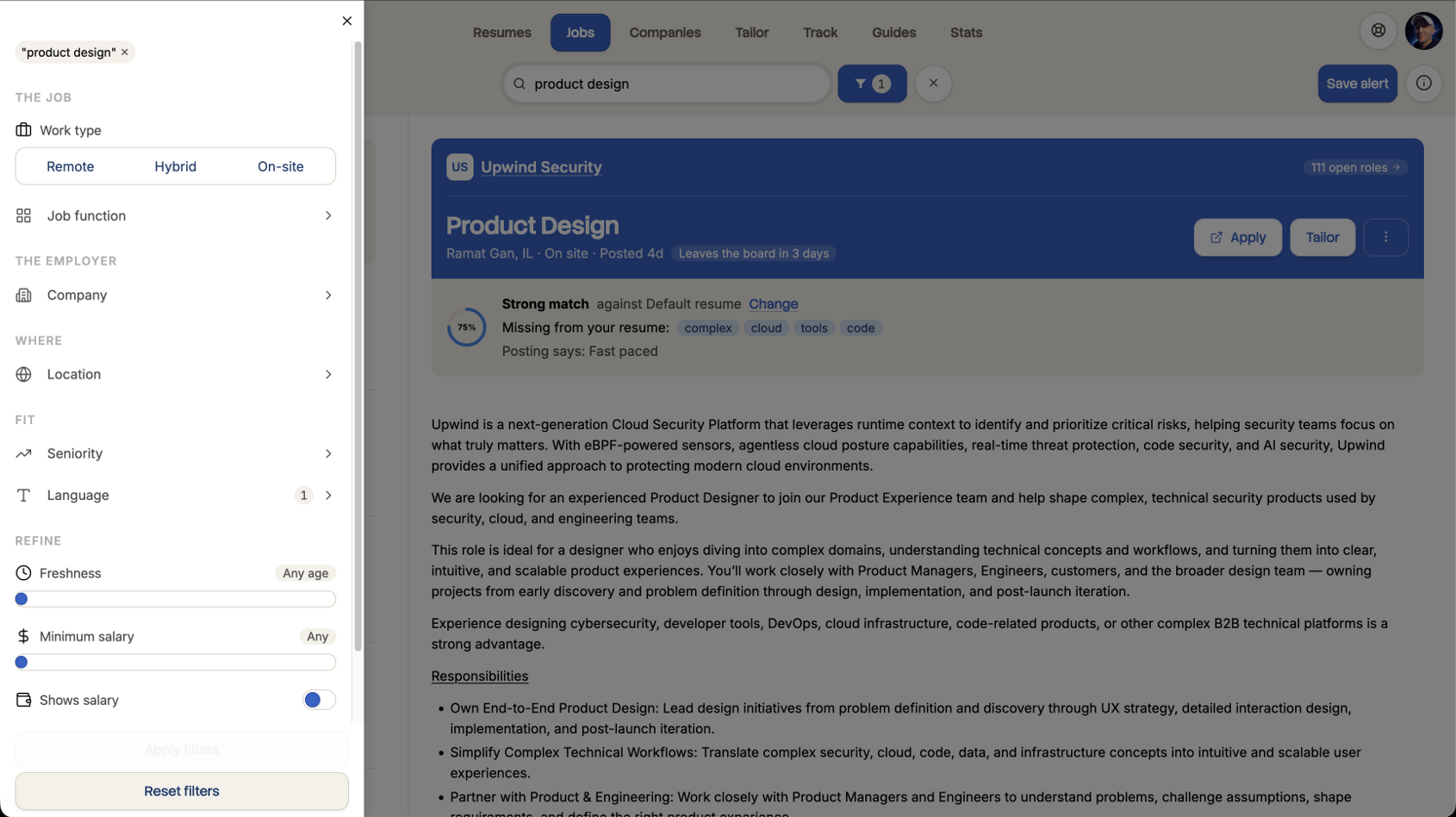
Job board with drill-down filters

Match One role at a time, scored against your resume. Swipe left to skip, right to save. A long search becomes a few minutes a day.

Why we built it
Scrolling 2.7 million roles is a job in itself. Match scores open roles against your resume and deals them one at a time, so you decide in seconds: skip or save.
Why it stayed
It turns the search into a short daily habit with a clear end. When you are through, it says so: “That is everything for now.”
How it changed
On the web it started as its own page. On the phone it folded into the board, next to List and Alerts, and the old web link still works for notifications that already went out.
What users say
“Ten minutes with my coffee and I have my shortlist for the day. It made the search feel finite.”
Match: roles scored against your resume, one at a time

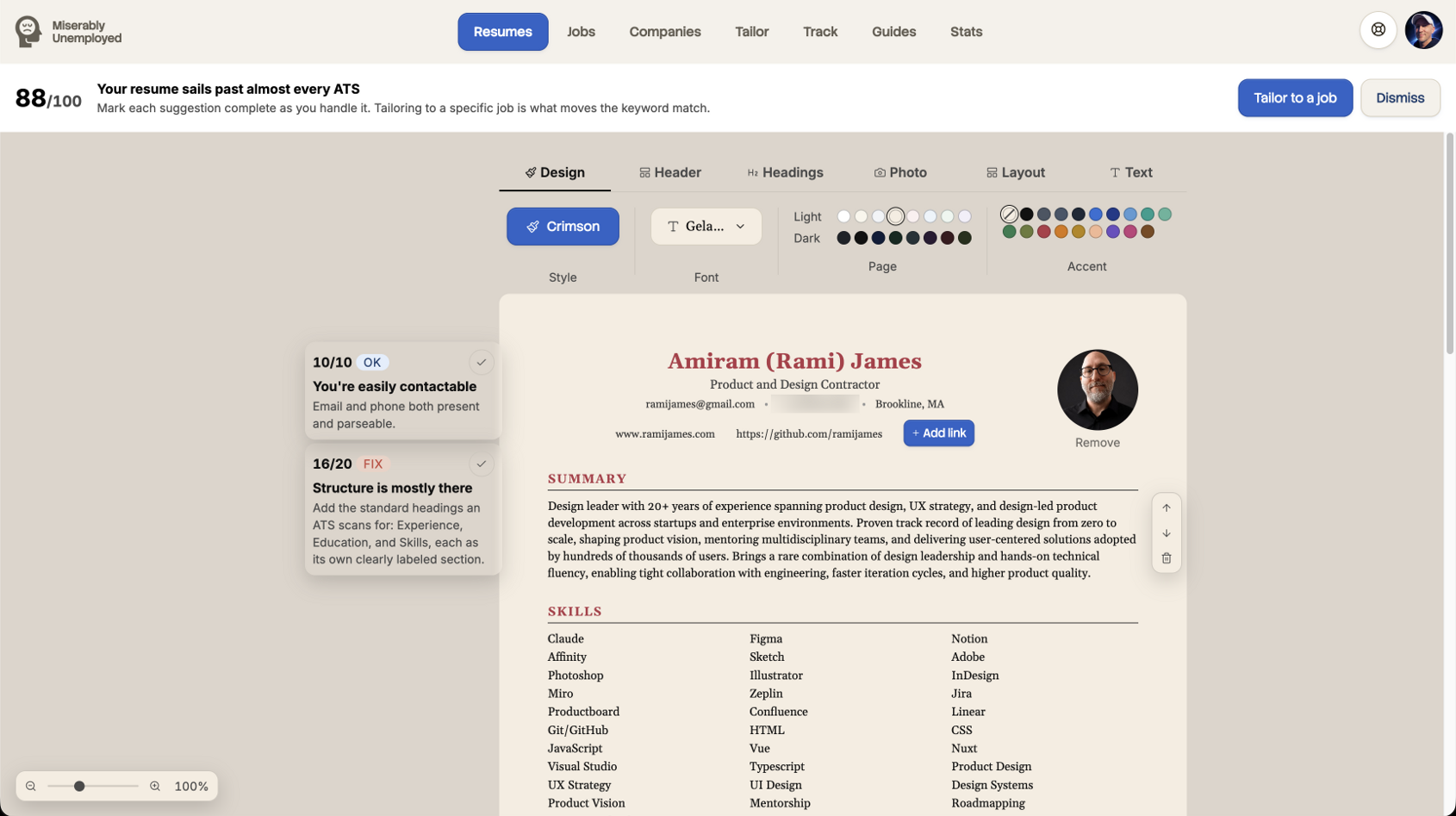
Resume builder Your master resume, with live ATS scores beside it. The notes on the left tell you what a hiring system will trip on, while you can still fix it.

Why we built it
Tailoring is only as good as the resume you start from. People needed one master resume for each direction they apply in, kept intact.
Why it stayed
Live ATS scores show what a hiring system sees while you type, so you fix problems in the editor, not after a rejection.
How it changed
In October I rebuilt the export: it keeps the whole document in your chosen font, breaks pages between bullets, and adds a running footer. Then came resume styles, and an editor made for the phone.
What users say
“Seeing the ATS score change while I edited was the first time I understood why I was not hearing back.”
Resume builder with live ATS scores

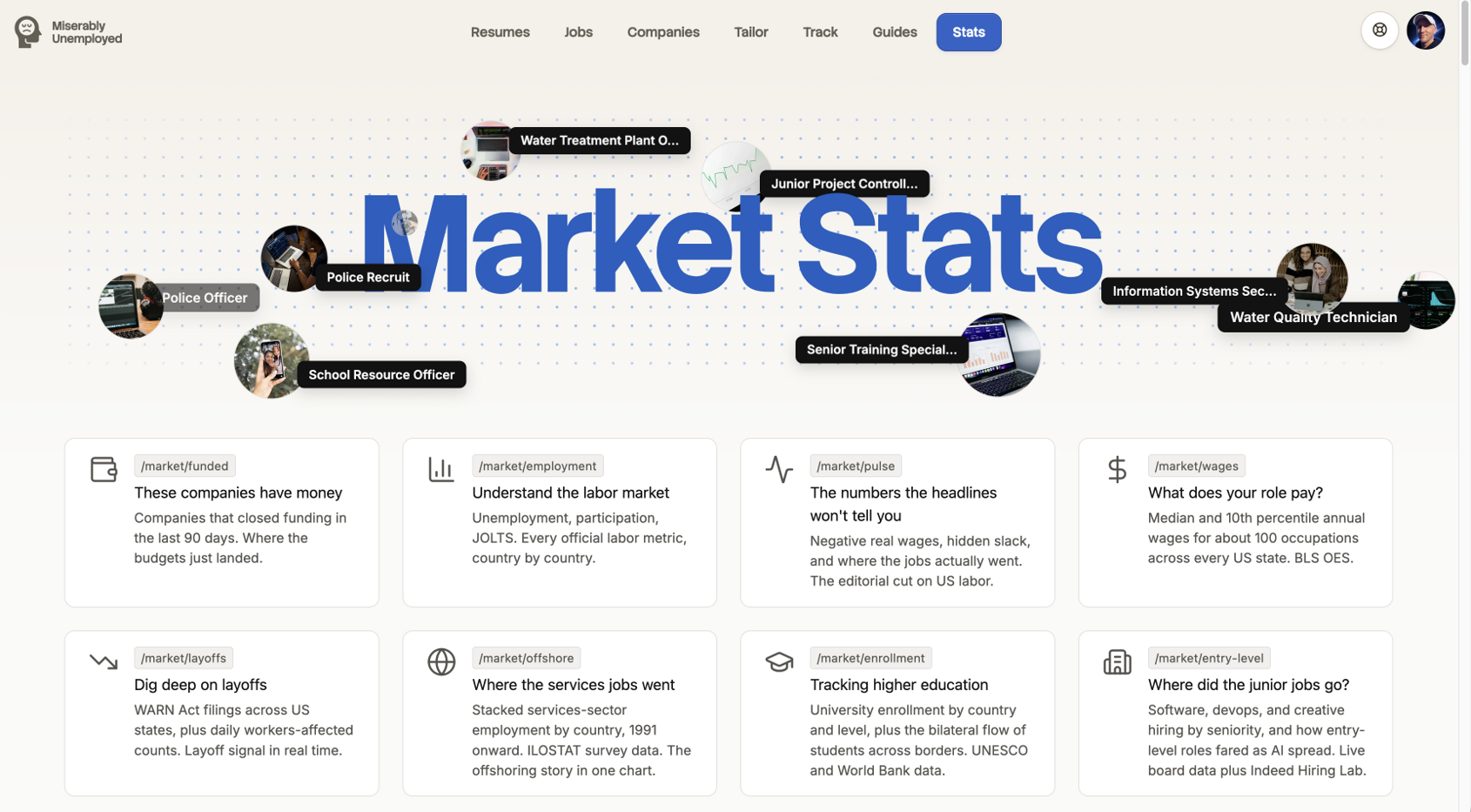
Market stats Who is hiring right now, and where the jobs come from. Public data on the size of the market, including the days when the number goes down.

Why we built it
Job seekers deserve the truth about the market, even when the true number is the smaller one.
Why it stayed
It almost did not. In August I cut most of it: twelve pages and nineteen endpoints cost real money and drew little traffic. In October the market pages came back on a leaner base, because public data that anyone can check builds trust in the board.
How it changed
From a dozen deep-dive pages to a focused set: who is hiring, where the jobs come from, and employment in the US and the world.
What users say
“I check the market page every Monday. It is the only place that tells me the honest number.”
Public market stats

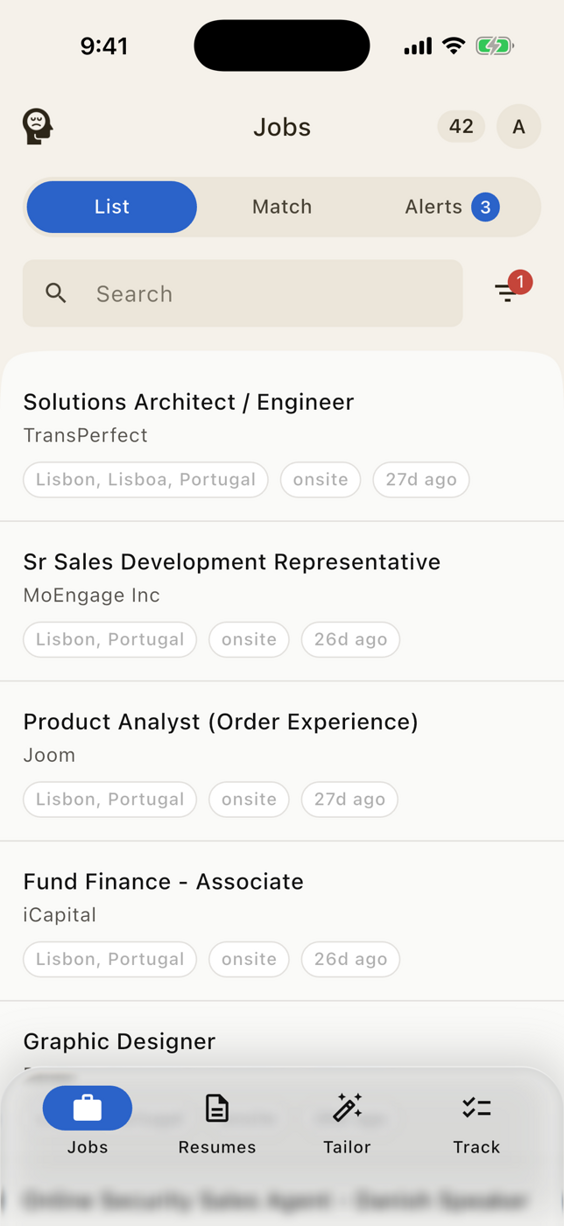
The iOS app The same board, Match, resumes, tailoring, and tracking, built for the phone. It is finished and tested on device, and not released yet.

Why we built it
A job search happens on the phone, in the gaps of the day. The app brings the board, Match, alerts, resumes, tailoring, and tracking to iOS.
Why it stayed
It talks to the same API as the website, so every feature works in both places from day one.
How it changed
Match moved into the board as a view. The resume editor was rebuilt for a small screen in October. The app is built and tested on device, and not released yet.
What users say
“I do most of my searching on the train. Having Match and alerts in my pocket is exactly what I wanted.”
iOS app: the job board
iOS app: the resume preview
iOS app: the resume editor

Book a
quick
call.

Pick a free slot and tell me about your idea. I confirm every request by email.